


As requirements for the impermeability, structural integrity, and construction precision of retaining structures in deep foundation pit and underground space projects continue to rise, traditional diaphragm wall techniques face challenges such as joint leakage, wall unevenness, and limited adaptability to various soil strata. The TRD method (Trench cutting Re-mixing Deep wall machine)—utilizing a chain-cutter mixing system—has emerged as a leading technology for soil retention, water cut-off, and trench wall reinforcement in deep foundation pits. Thanks to a comprehensively upgraded equipment system, it is highly adaptable to complex geological conditions and high-standard construction requirements.
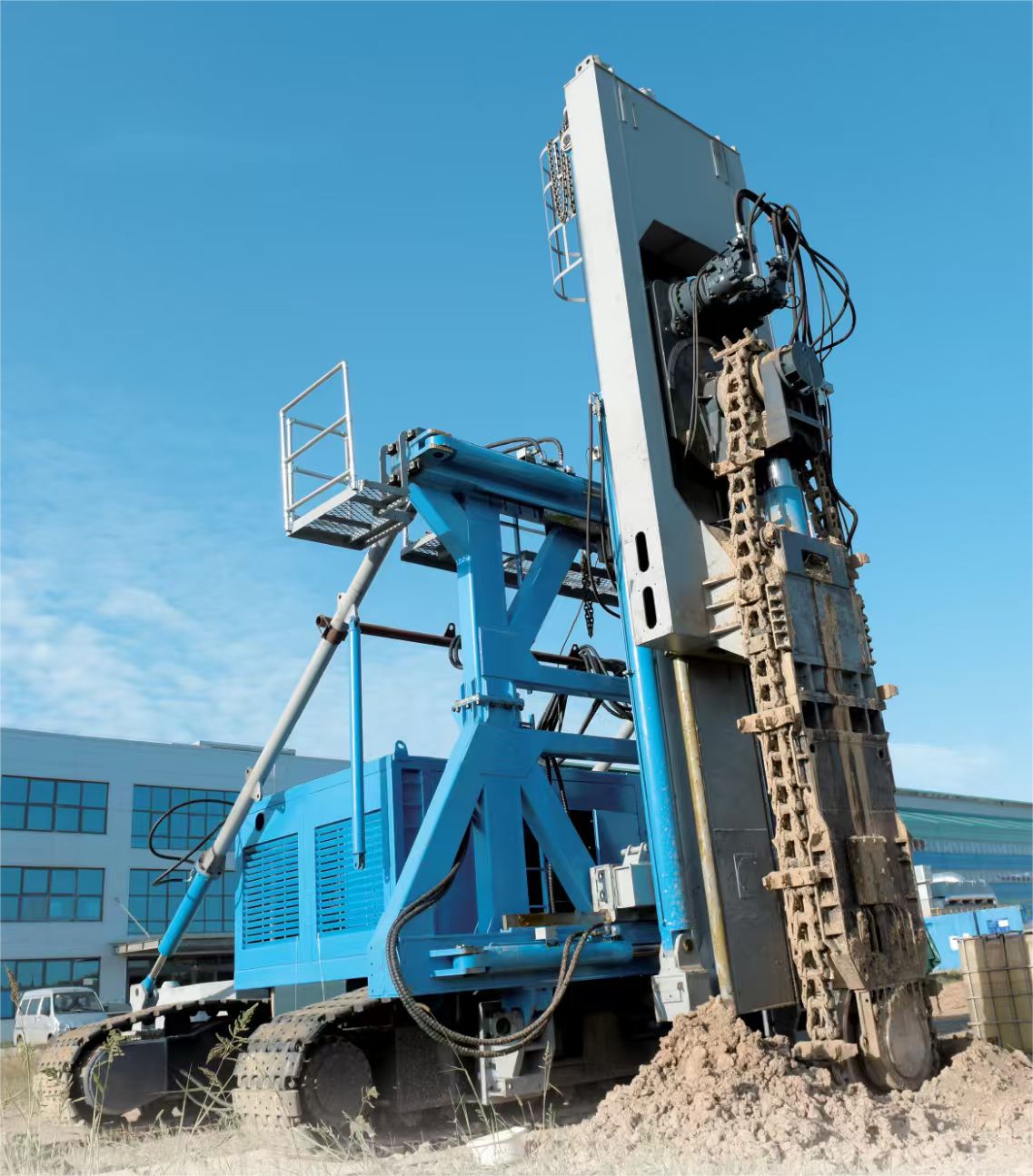
The TRD method relies on an efficient, advanced operating principle: a chain-cutter tool vertically cuts the soil to the design depth while advancing horizontally at a constant speed. Simultaneously, cement slurry is injected and thoroughly mixed with the soil to form a continuous, seamless cement-soil wall of uniform thickness. Core materials, such as H-beams, can be uniformly inserted into the wall during construction to create a high-strength composite retaining and cut-off structure. This effectively resolves industry-wide issues associated with traditional segmental construction—such as joint leakage and insufficient rigidity—thereby significantly enhancing the structural integrity of the retaining wall.
The equipment demonstrates exceptional adaptability to various working conditions, handling standard strata—including cohesive soil, sandy soil, sand-gravel mixtures, and gravel layers—as well as complex geological formations such as dense sand layers (30–60 blows) and soft rock with a uniaxial compressive strength of up to 10 MPa. It achieves wall depths of up to 70 meters, with a standard verticality deviation of ≤1/250 (improving to ≤1/300 for trench wall reinforcement) and wall thicknesses ranging from 400 mm to 950 mm. The resulting cement-soil wall is uniform and dense, boasting an unconfined compressive strength of 0.5–2.5 MPa and a permeability coefficient as low as 1×10⁻⁶ to 10⁻⁷ cm/s in sandy soil, ensuring excellent water-blocking and anti-seepage performance.
The equipment features modular power, hydraulic, electronic control, and chassis systems, delivering a comprehensive upgrade in overall performance. The power unit supports dual-mode switching between diesel and electric power; it is equipped with either an imported engine or a high-performance electric system featuring a soft-start device, allowing the electric motor to be started or stopped as needed to effectively reduce energy consumption. The hydraulic system utilizes a renowned high-flow main pump and an imported Kawasaki hydraulic motor, delivering an operating pressure of 34 MPa; combined with load-sensing auxiliary control, it ensures stable pressure, minimal heat generation, and superior operational efficiency.
The machine features a fully electronic-hydraulic control design and dual displays for real-time monitoring of operating status, offering high intelligence integration and fewer potential failure points. It includes a deluxe cab for convenient and comfortable operation. Built on a proven crawler crane undercarriage, the unit offers excellent stability and a compact footprint; the tracks can be retracted for integral transport, eliminating the need for complex disassembly or reassembly. With an overall height kept under 12 meters and a low center of gravity, it ensures high operational safety, making it perfectly suited for underground construction projects requiring high precision, strict anti-seepage standards, and operation in space-constrained environments.
Post time: Aug-03-2026